Prefabricated construction site buildings are widely used in the construction industry thanks to their quick installation and portability. However, for these buildings to be used efficiently, thermal insulation must be applied correctly.
Thermal insulation is important for balancing indoor temperatures, reducing energy consumption and making the workspace more efficient.
Thermal Insulation Methods for Prefabricated Containers
Choosing the Right Insulation Material
The material used for thermal insulation directly affects performance. Materials commonly used in prefabricated site buildings include:
- Polyurethane foam
- Polystyrene foam
- Glass wool
- Rock wool
The chosen material should have a high thermal insulation value, offer fire resistance and be long-lasting.
Quality of Application
Applying the insulation material correctly is just as important as choosing it. During application:
- No gaps or cracks should be left
- The material must be in full contact with the surface
- Fastening must be done thoroughly
Poor workmanship leads to heat loss and energy inefficiency.
Exterior Insulation
The building’s exterior should be protected against sunlight and outdoor weather conditions. Exterior cladding and insulation systems play an important role in reducing heat loss.
Interior Insulation
Insulation applied to interior surfaces helps maintain the indoor temperature. Walls, ceilings and floors should be insulated as one complete system.
Door and Window Insulation
Doors and windows are where heat loss is greatest. That is why:
- Insulated frame systems should be used
- Gaps around the edges should be sealed
Ventilation and Airtightness
Air circulation is necessary for good indoor air quality. However, uncontrolled airflow can cause heat loss. That is why:
- Controlled ventilation systems should be used
- Air leaks must be prevented
Why Choose Prefabricated Construction Site Buildings?
Prefabricated site buildings offer many advantages in modern construction projects.
Quick Installation
Thanks to factory-made modules, assembly on site takes very little time.
Portability
The buildings can be dismantled and reused on different projects.
Cost Advantage
Optimized production and installation processes lower the total cost.
Environmental Impact
The controlled production process reduces waste and environmental impact.
For the prefabricated site buildings that suit you best, click here.
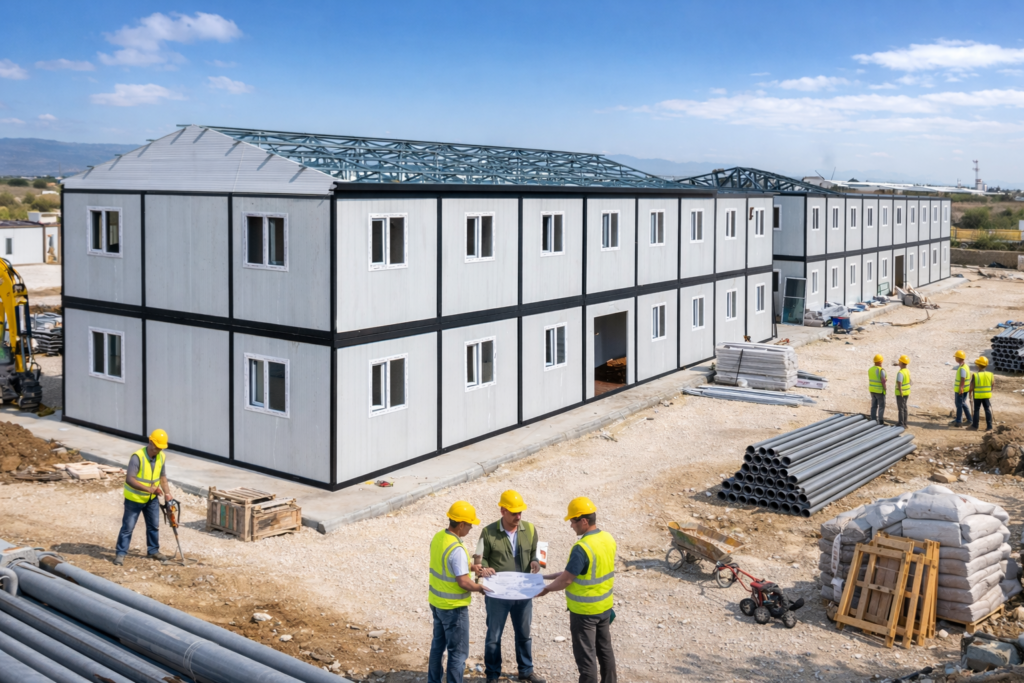
Mobility and Flexibility in Prefabricated Site Buildings
Thanks to their modular structure, prefabricated container systems adapt quickly to different needs.
- Easy to transport
- Can be reinstalled in different locations
- Can be expanded as needed
- Interior layout can be changed
These features provide operational flexibility throughout the project.
Frequently Asked Questions
Why is thermal insulation important in prefabricated containers?
By balancing indoor temperatures, it increases personnel productivity, and by preventing moisture buildup in the structure, it extends the building’s service life. It also saves energy by allowing heating and cooling systems to run less.
What is the best thermal insulation material?
Polyurethane-core sandwich panels are the best choice for high thermal performance, while rock wool is the best option for projects where fire safety is the priority. The choice should be based on the climate of the region where the project will be carried out.
How is heat loss prevented in prefabricated containers?
High-density insulation materials should be used in the roof, wall and floor panels, and door and window joints should be sealed with airtight gaskets. Breaking thermal bridges with the right details eliminates leaks completely.
Does thermal insulation lower energy costs?
Yes. Effective insulation keeps site operating costs to a minimum by saving up to 50% on heating and cooling expenses. Running climate control equipment for shorter periods is critical for energy efficiency.
Can prefabricated containers be insulated after installation?
Yes. The thermal performance of existing buildings can be improved later by adding extra panels on the outside or insulation layers on the inside. However, the highest efficiency is achieved when the building is designed for the local climate at the production stage.