
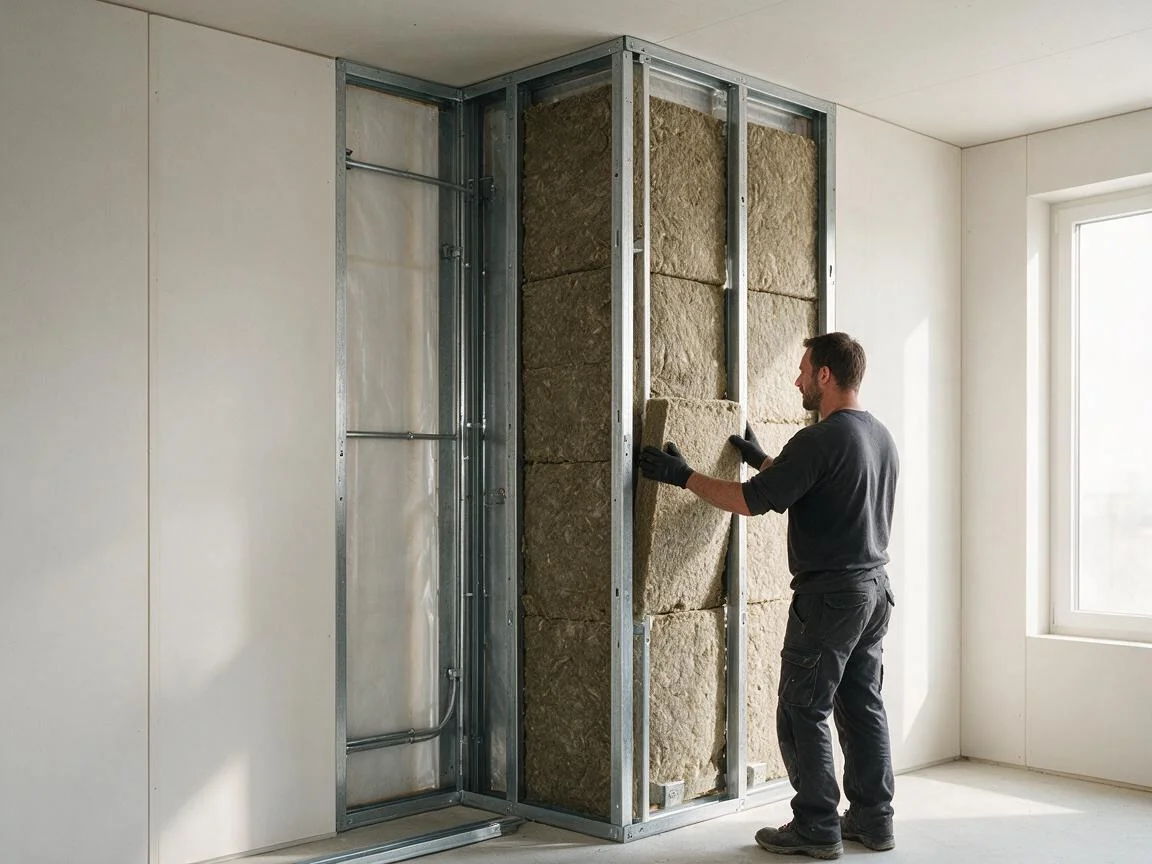
Rock wool, also known as stone wool, is a mineral-based insulation material made by melting natural rocks such as basalt at high temperatures and spinning them into fibers. Thanks to its fibrous structure, it supports thermal and sound insulation while also giving buildings important advantages in terms of fire safety.
Used in a wide range of buildings, from homes to prefabricated structures and from construction site buildings to industrial facilities, rock wool can be produced in different forms such as boards, blankets, pipe sections and loose fill. The thickness, density and technical properties of the product are determined by where it will be applied.
What Is Rock Wool Used For?
The main function of rock wool is to limit heat transfer through a building. Its fibrous structure also helps absorb sound waves, while its fire-resistant varieties support the fire safety of buildings.
The main functions of rock wool are as follows:
- It helps reduce heat transfer between the indoor and outdoor environment.
- It helps keep indoor temperatures balanced in summer and winter.
- It helps reduce noise coming from outside.
- It helps limit sound transmission between rooms.
- It supports the fire safety of the building.
- It helps reduce the energy used for heating and cooling.
- It improves comfort in prefabricated and steel buildings.
- It helps control the risk of condensation.
The results of a rock wool insulation job do not depend on the quality of the material alone. The thickness and density of the product, the installation method and its compatibility with the other layers of the building system also have a direct impact on insulation performance.
How Is Rock Wool Made?
To make rock wool, basalt and similar mineral raw materials are melted at high temperatures. The molten material is passed through special production systems that turn it into fine fibers. These fibers are then combined with binders in specific proportions and shaped to suit their intended use.
Later in the production process, the material is brought to the required density and thickness and formed into boards, blankets or pipe sections. Some rock wool products may have aluminum foil, glass tissue or other surface facings.
A rock wool board intended for an exterior facade and a product intended for use inside a partition wall may not have the same technical properties. That is why products should be chosen according to the needs of the part of the building where they will be installed, not just by the name of the material.
What Are the Advantages of Rock Wool Insulation?
Rock wool insulation is used in many types of buildings because it can support thermal, acoustic and fire performance within a single system. However, it should be kept in mind that the performance achieved depends on the product’s properties and the quality of the installation.
Supports thermal insulation
Rock wool is an insulation material with low thermal conductivity. When installed in the building envelope at the right thickness and without interruptions, it helps limit heat loss in winter and heat gain from outside in summer.
Effective thermal insulation helps keep indoor temperatures more stable, which makes it possible to use heating and cooling systems in a more controlled way.
Contributes to sound insulation
The fibrous, porous structure of rock wool absorbs part of the sound energy, helping reduce sound transmission between building elements. This makes it suitable for partition walls, floors between stories, roofs, mechanical rooms and noisy work areas.
Sound insulation performance does not depend on rock wool alone. The wall layers, sheathing boards, structural system and connection points also matter, as does leaving no gaps during installation.
Improves fire safety
Unfaced rock wool products with the appropriate technical properties can be classified as Class A1 non-combustible materials. This property allows rock wool to be used in facades, fire compartments, roofs, service penetrations and industrial buildings.
Not every rock wool product has the same reaction-to-fire class. The fire class and certificates of conformity of the product to be used should be checked in the manufacturer’s technical documentation.
Provides dimensional stability
When used under the right conditions, rock wool keeps its dimensions despite temperature changes. This helps limit the gaps and deformation that may develop in the insulation layer over time.
For the material to perform over the long term, it must be stored in a dry, sheltered area before installation.
Can be used in different types of buildings
Rock wool insulation solutions can be used in reinforced concrete, prefabricated, light steel and industrial steel buildings. Depending on the requirements of the project, it can be integrated into walls, exterior facades, roofs, floors and building services.
The availability of products with different densities, thicknesses and surface finishes broadens the range of applications for rock wool.
Where Is Rock Wool Used?
Rock wool can be used in various parts of a building to support thermal, sound and fire insulation. A product with the right density and mechanical properties should be chosen for each application.
The main areas where rock wool is used include:
- Exterior wall insulation systems (EIFS/ETICS)
- The back of curtain wall and rainscreen facades
- Interior partition walls
- Prefabricated building walls
- Light steel building systems
- Sandwich panel production
- Roof and terrace insulation
- Floors between stories
- Suspended ceiling systems
- Ventilation and air conditioning ducts
- Boiler and mechanical rooms
- Industrial facilities
- Fire doors and fire compartments
- Site offices
- Prefabricated dormitory and dining hall buildings
- Containers and modular buildings
Using the same type of rock wool for every application is not the right approach. For facade, roof, wall and building services applications, the product’s thickness, density, compressive strength and reaction-to-fire class should each be assessed separately.
How Is Rock Wool Installed on Exterior Facades?
Exterior facade rock wool is used on the outer walls of buildings to support thermal and fire insulation. In exterior wall insulation (EIFS/ETICS) applications, rock wool boards are bonded to the surface with a suitable adhesive and secured with mechanical anchors.
Once the boards are fixed in place, the plaster, reinforcing mesh, primer and final facade finish are applied. Leaving no gaps between the rock wool boards and preparing the board joints correctly are important for the continuity of the insulation.
In curtain wall and rainscreen facade systems, on the other hand, rock wool boards are placed between the main wall and the exterior cladding. In these applications, the insulation must be protected from outdoor conditions and the facade details must be designed to prevent water ingress.
Exterior facade rock wool insulation:
- Improves the thermal insulation performance of the building.
- Helps reduce outdoor noise.
- Offers advantages in terms of fire safety.
- Helps create a continuous insulation layer in the building envelope.
- Helps maintain more stable indoor temperatures.
For the installation to last, the adhesive, anchors, plaster and other system components used must be compatible with the rock wool boards.
What Sizes Does Rock Wool Come In?
Rock wool dimensions can vary depending on the product’s application and the manufacturer. One of the most common sizes for exterior insulation boards is 60 × 120 cm. However, products can also be manufactured in other widths and lengths for different applications.
Common thickness options for rock wool boards include:
- 30 mm
- 40 mm
- 50 mm
- 60 mm
- 80 mm
- 100 mm
- 120 mm
- 140 mm and above
These sizes are not standard for all rock wool products. They may vary depending on the manufacturer, product range and application.
When determining rock wool thickness, the climate zone of the building, the wall system, the target thermal transmittance (U-value) and the relevant insulation standards must be taken into account. Rather than simply choosing a thicker product, the necessary thermal insulation calculation should be carried out for the system as a whole.
What Should the Density of Rock Wool Be?
Rock wool density is the weight of one cubic meter of the material in kilograms. Rock wool products are manufactured in different densities depending on their application.
A product used inside a partition wall and an exterior facade board that will be exposed to mechanical loads under plaster have different densities and strength properties. That is why choosing a product by its density value alone is not the right approach.
When choosing rock wool, the following technical properties should be examined together:
- Thermal conductivity
- Reaction-to-fire class
- Compressive strength
- Tensile strength perpendicular to faces
- Water absorption
- Water vapor diffusion resistance
- Dimensional stability
- Product thickness
- Area of application
The right rock wool product is the one that meets all of the technical values the project requires as a whole.
Is Rock Wool Waterproof?
Rock wool is not a waterproofing material. Although some rock wool products are water-repellent, they should not be used in place of waterproofing membranes.
In roof and facade applications, system details should be designed to prevent rainwater or outdoor moisture from reaching the rock wool layer. Waterproofing membranes, facade cladding, drainage cavities and ventilation details should be installed to suit the project.
The insulation performance of rock wool products that are exposed to water for long periods or stored incorrectly can be adversely affected. Before installation, products should be kept in a dry, covered area raised off the ground.
What Is the Difference Between Rock Wool and Glass Wool?
Rock wool and glass wool are two different insulation materials in the mineral wool family. Both can be used for thermal and sound insulation. However, they can differ in their raw materials, densities, mechanical properties and areas of use.
Rock wool is generally preferred for exterior facade, roof and industrial applications that require higher density and mechanical strength. Glass wool, thanks to its light and flexible structure, can be used in attics, partition walls and building services systems.
When choosing a product, you should not simply compare the general properties of the materials. The thermal, acoustic, fire and mechanical performance values the project requires should be evaluated together.
Using Rock Wool in Prefabricated Buildings
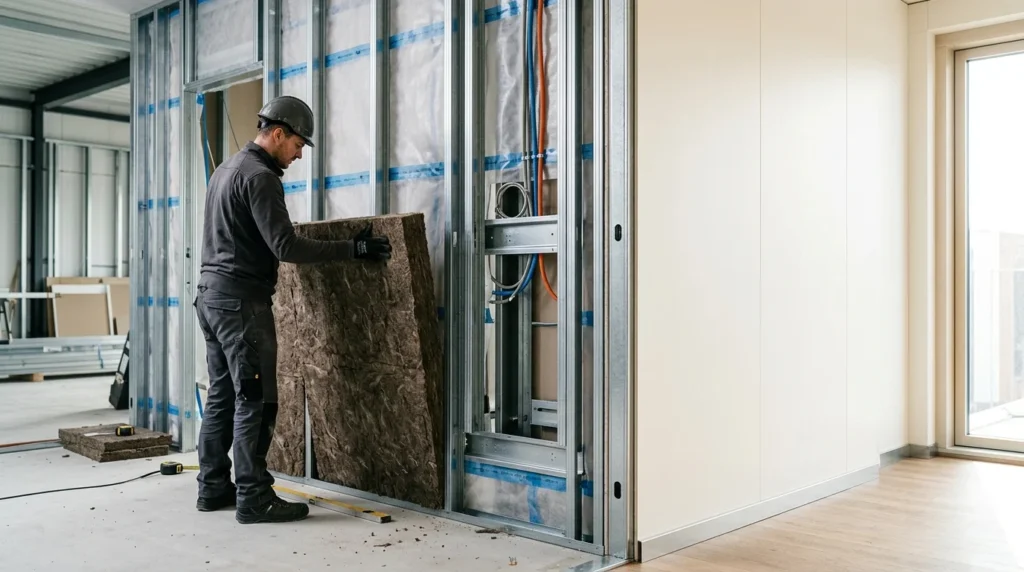
Rock wool is one of the insulation materials that can be used in prefabricated and light steel buildings. It can be installed inside wall panels, in roof systems, between floors and behind exterior cladding.
Using rock wool in prefabricated buildings contributes to:
- Balancing indoor temperatures,
- Reducing outdoor noise,
- Limiting sound transmission between rooms,
- Supporting the fire safety of the building,
- Improving energy efficiency.
It is important to fit rock wool boards between the structural profiles without leaving any gaps. Breaks in the insulation that may occur where electrical and mechanical services pass through should be closed with appropriate details.
Since the wall and roof layers of prefabricated buildings can vary from project to project, the thickness and density of the rock wool to be used should be determined through technical calculations.
What to Consider When Choosing Rock Wool
When choosing rock wool, the decision should not be based solely on the product’s price or thickness. The area where the insulation will be used and the performance expected from the building should be determined in advance.
The main points to consider when choosing a product are:
- Identify the part of the building where the rock wool will be used.
- Calculate the required insulation thickness.
- Review the declared thermal conductivity value.
- Check the reaction-to-fire class.
- Compare density and mechanical strength values.
- Verify that the product complies with the relevant standards.
- Choose a product that is compatible with the other building and insulation components.
- Follow the manufacturer’s installation and storage instructions.
Installation quality matters as much as choosing the right material. Gaps between boards, unsuitable anchors or poorly designed facade details can reduce the performance of rock wool insulation.
The Importance of Rock Wool Insulation in Buildings
Rock wool is a versatile material that can support thermal, sound and fire insulation within the same building system. It can be used in many areas, from exterior facades to roofs and from partition walls to prefabricated buildings.
To get the expected results from rock wool insulation, the product’s thickness, density, fire class and mechanical properties should be matched to the needs of the project. The right product choice and professional installation support a building’s energy efficiency, safety and comfort over the long term.